Watch. Warning. Advisory.
Routinely understood backwards.
Three words the weather service will use on the worst day of your year. Here is what each one actually asks of you: in one sentence apiece.
The short version: a tornado watch means conditions are favorable: be ready, and do the things that take time. A tornado warning means it is occurring or imminent: act now, and stop preparing. An advisory means conditions are hazardous or inconvenient, but below warning criteria. Those definitions come straight from the National Weather Service.
- Watch
Potential · typically inside 48h. Conditions are favorable. This is when you do the tasks that take time: fuel the cars, charge everything, fill the containers, bring in the furniture, brace the garage door.. Be ready.
- Warning
Occurring or imminent. It is happening. There is no time left for tasks: there is only time for the plan. Shelter now, lowest floor, interior room, away from windows.. Act. Stop preparing.
- Advisory
Below warning criteria. Significant conditions that are inconvenient or hazardous, but below the local warning thresholds. Not nothing. Not an emergency.. Pay attention.
If the taco version helps, use it: a watch means the ingredients are on the counter; a warning means the taco is made. It is silly, and it is also exactly the NWS distinction: potential versus occurring.
The manufactured-home exception. If you live in a manufactured or mobile home, a watch is when you leave: not a warning. There is no safe room in the structure, and the warning may not leave enough time to reach one elsewhere.
The part most people never learn
The numeric criteria behind these words are set locally, office by office. The same words mean different amounts of weather in different places: in the Baltimore–Washington forecast area, a Winter Storm Warning needs 5 inches of snow (6 in the westernmost counties), an Ice Storm Warning needs a quarter inch of ice, and the advisory threshold drops to one inch if the snow hits at rush hour. Your forecast office publishes its own table. Find it once, and the words become numbers.
Why sirens make this worse, not better
Outdoor warning sirens are built to alert people who are outdoors. They are not designed to be heard inside a modern insulated house, over a television, in the rain, with the wind blowing the wrong way: yet many households treat silence as safety. Three things worth knowing: sirens may not sound at all for a hazard that warrants shelter (activation policy varies by jurisdiction); a siren is not an all-clear system; and hearing one is not confirmation of what the hazard is. It is a prompt to check your alert channels: never the primary path.
"The sirens sounded twice. The second time, people went to their windows to look: not to their shelters."
: Joplin, Missouri, May 22, 2011
That sentence is why this page exists. Joplin had 24 minutes of warning: nearly double the national average: and it still became the deadliest single tornado in modern American history. The full story is Episode 1 of The Warning Hour:
Questions people ask
- What is the difference between a tornado watch and a tornado warning?
- A watch means conditions are favorable: be ready, do the preparations that take time. A warning means a tornado is occurring or imminent: act now and stop preparing.
- Why do tornado sirens go off when there is no tornado?
- Activation policy is set by each jurisdiction: some sound sirens for severe thunderstorm winds, tests, or county-wide warnings that never touch your street. Look up your own jurisdiction's policy; it is usually published, and usually surprising.
- Is a tornado watch or warning worse?
- A warning is the more urgent of the two: it means the hazard is occurring or imminent. A watch comes first and is your working time; a warning is your acting time.
- What should I do during a tornado watch?
- The tasks that take time: fuel the cars, charge devices, fill water containers, move vehicles and furniture, review where the household shelters, and put shoes and a flashlight in the safe room. In a manufactured home, a watch is when you leave.
- National Weather Service: watch / warning / advisory definitions ("potential" vs "occurring or imminent")
- NWS Baltimore/Washington (LWX), "Warnings, Watches and Advisories Defined": local numeric criteria, including the quarter-inch Ice Storm Warning threshold
- NWS Central Region Service Assessment: Joplin, Missouri Tornado, May 22, 2011
Write the three definitions on your family's trigger plan in your own words, with the action next to each, and walk through them once with everyone in the house. The free family emergency plan template has a line for exactly this, and the tornado preparedness checklist covers the watch-hour tasks. Your state's alert systems and contacts are on your state's storm page.
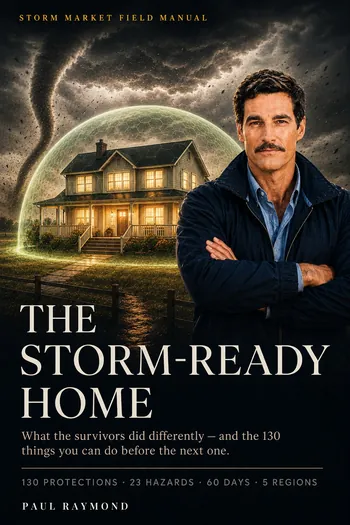
Warning literacy is one chapter. There are 23 more. The Storm-Ready Home dedicates eleven protections to alerts alone: two independent alert paths, county enrollment, SAME radio programming, the trigger plan. 486 pages, 130 numbered protections, built from the post-storm reports.
Instant PDF · Pay once, own it forever · 7-day money-back guarantee
Sources for this field guide
Get the book
The Storm-Ready Home is a 486-page manual built from post-storm reports: 130 numbered protections, 23 hazard playbooks, the 60-day sequence, and the 61-page printable binder, every figure cited.