Free Checklist
Tornado preparedness checklist: plan, kit, and the trigger that matters most.
Tornado preparedness comes down to three things: a named safe room you can reach in under sixty seconds, two independent ways to hear the warning, and a written trigger that moves you to shelter without waiting to look outside first. This checklist, and the sirens-alone mistake it corrects, comes straight from the National Weather Service's own investigation of the 2011 Joplin tornado.
Joplin's 2011 tornado had 24 minutes of warning lead time: nearly double the national average. It still became the deadliest single tornado in modern American history. The National Weather Service's own assessment found the cause wasn't the forecast; it was that most residents didn't take shelter on the first siren, waiting instead for a second, "non-routine" confirmation. This checklist is built to close that exact gap.
This page is one protection out of 130. The manual carries all of them, in order, with the binder forms that go with each. Get the book, $9.99 →
The plan
- Name your safe room now
Interior room, lowest floor, zero exterior walls, reachable in under sixty seconds. Full picking guide: tornado safe room.
- Write the trigger: "warning means we go, not verify"
The NWS found that most Joplin residents sought confirmation: looking outside, calling a relative: before sheltering, and that verification consumed the exact time the warning bought.
- Know watch vs. warning
A watch means conditions are favorable: be ready. A warning means it's happening or imminent: act now, stop verifying.
- Don't rely on sirens alone
Outdoor sirens are built to be heard outdoors: not through insulated walls, over a television, or in the rain. Some jurisdictions don't sound sirens for every warning, and a siren is not an all-clear system.
- Program a NOAA weather radio to your county only
A radio broadcasting for a fifty-mile radius wakes you for storms nowhere near you and gets switched off within a week. Programmed to your county's SAME code, it's something you can actually leave on.
The kit
- A helmet per person, kept in the safe room
In one CDC review of the April 2011 outbreak, 21.9% of tornado death certificates noted a head injury. Helmets aren't proven to reduce deaths and aren't a substitute for shelter: they're a cheap addition on top of a good room.
- Real shoes and a headlamp, in the room
A light or shoes you have to find in the dark are ones you won't have when the room is full of debris.
- Blankets, in the room
CDC's own recommendation places blankets and helmets in the safe room itself, not the hall closet.
- Your written trigger plan, printed and posted
See the full family emergency plan template.
Reading a radar loop well enough to decide
You don't need to forecast: you need three answers. Is it coming toward you: watch a loop rather than a still image, since motion is the whole signal. How long do you have: rough is fine, the answer you need is "twenty minutes" versus "two hours." Is this the dangerous kind: learn what a hook or bounded structure looks like in your area's typical storms. Radar shows precipitation and motion, not the ground: it is not confirmation a tornado is on the ground, and its absence is not proof of safety.
- What is the most important item in a tornado preparedness plan?
- The trigger plan: a written, pre-agreed rule that moves your household to shelter on the warning itself, without waiting to verify it first. The NWS found that verification delay was the leading factor behind Joplin's death toll despite 24 minutes of warning.
- What should be in a tornado kit?
- A helmet per person, real shoes and a headlamp, blankets, and a NOAA weather radio programmed to your county, all kept in the safe room itself.
- Can I rely on outdoor tornado sirens?
- No, not alone. Sirens are designed to be heard outdoors and often aren't audible inside a modern insulated house. Activation policy varies by jurisdiction, and a siren is not an all-clear system. Treat it as a supplement to a NOAA weather radio, never the primary alert.
- What's the difference between a tornado watch and a warning?
- A watch means conditions are favorable for tornadoes: be ready. A warning means a tornado is occurring or imminent: act immediately, there is no time left for prep tasks.
- NWS Central Region, Service Assessment: Joplin, Missouri, Tornado: May 22, 2011
- CDC, "Tornado-Related Fatalities: Five States, Southeastern United States, April 25–28, 2011," MMWR 2012;61(28):529–533
- NOAA Weather Radio All Hazards, "County Coverage Listing by State"
This checklist is three protections. The book has 130. A 486-page manual built from the post-storm reports: including Joplin's: with 130 numbered protections across 23 hazard playbooks, a 60-day sequence, and the full printable binder.
Instant PDF · Pay once, own it forever · 7-day money-back guarantee
Not ready to buy? Get your free state packet instead: your state's specific hazards, agencies, and mitigation rules.
See also: tornado safe room, family emergency plan template, and your state's tornado risk in our state guides. Read the full story in Field Notes: The 24 Minutes Nobody Believed.
Sources for this page
Get the book
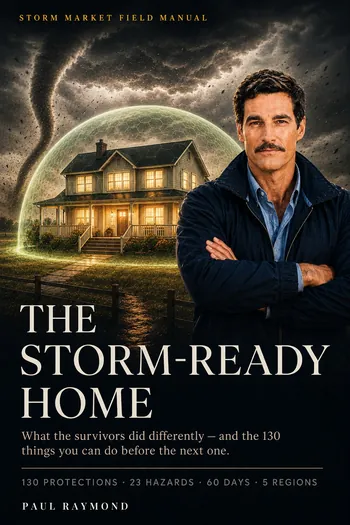
The Storm-Ready Home is a 486-page manual built from post-storm reports: 130 numbered protections, 23 hazard playbooks, the 60-day sequence, and the 61-page printable binder, every figure cited.
The printable pack free
Want all seven checklists as one printable PDF?
Every checklist on this site, laid out for the fridge door, plus three forms from the manual's binder. Emailed to you in one file.
Free. One email. Unsubscribe any time.