Free Checklist
Family emergency plan template, with a real example.
A family emergency plan is a written, pre-agreed set of decisions: not a folder of pamphlets. This free printable PDF gives you the four sections that matter: a trigger plan with a worked example, two independent alert paths, your evacuation zone, and your safe room. Fill it in once, print it, put it where everyone can see it.
Most "emergency plan" templates online are a checklist of supplies. That is a different document. A family emergency plan is a set of decisions made calmly, in advance, so that nobody in your house has to make them for the first time while frightened. This template is built around the one mechanism that actually changes outcomes: deciding the trigger before the warning arrives.
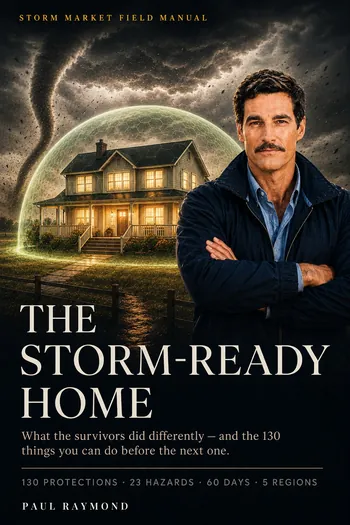
This page is one protection out of 130. The manual carries all of them, in order, with the binder forms that go with each. Get the book, $9.99 →
The trigger plan: the core of the template
People do not act on warnings. They seek to verify them first: a look out the window, a call to a relative, the television: and verification consumes exactly the time the warning bought. That pattern was a documented finding in the National Weather Service's own assessment of the 2011 Joplin, Missouri tornado, where most residents did not take shelter until they had additional confirmation beyond the siren itself.
A trigger plan fixes this by moving the decision to a calm moment and writing it down. Fill in your own version of these lines: five to ten is enough:
"When a tornado warning includes our location: we go to the room. We do not look outside."
- Tornado warning for our county
Action: everyone goes to the safe room named below. No verification step.
- Hurricane watch for our county
Action: cars fuelled, documents in the car, garage door braced.
- Evacuation order for our zone
Action: leave within thirty minutes. The argument about whether it's necessary does not happen.
- Red Flag warning issued
Action: go-bags go in the car.
- Your household's own trigger
Write one specific to a hazard your family actually faces.
Read it out loud with the household once at the start of each season. A plan that is written and never said out loud is a piece of paper that makes you feel prepared without changing what happens.
Two independent alert paths
Every trigger plan depends on actually hearing the warning. Fill in two paths that fail differently, because every single path has a routine failure mode: a phone on silent, a dead battery, a congested cell network, or an indoor room a siren was never built to reach.
- Wireless Emergency Alerts, confirmed ON
Check tonight that emergency alert categories haven't been switched off in your phone's settings.
- NOAA weather radio, with battery backup, programmed to your county
Placed where you sleep. It does not depend on cell networks, internet, or grid power.
- County or city emergency alert enrollment
A separate, free sign-up from your county's own site: the alert most likely to be specifically about your street.
Evacuation zone and safe room
Write both of these down now, because both are the wrong things to be figuring out for the first time during a warning.
- Our evacuation zone
Zones are drawn from surge or fire-behavior modeling, not distance from water or trees. Look yours up and write the zone letter or number here.
- Our safe room
The interior room, lowest floor, fewest exterior walls, of everyone's houses. Time the slowest person getting there: over sixty seconds means pick a closer room.
- Out-of-area contact
Someone outside your immediate region everyone can reach if local lines are down.
- Meeting point
A place to reunite if you're separated when a warning hits.
What this plan doesn't do
A trigger plan is not a supply list: see our go bag checklist for what to actually pack, and it is not a substitute for the fuller documentation your household needs after an event: see the emergency binder. It also has to be practiced, not just filled in: a plan nobody has said out loud is not a plan.
- What should be included in a family emergency plan?
- At minimum: a written trigger plan naming the exact signal that moves your household to action, two independent ways to receive alerts, your evacuation zone, your named safe room, an out-of-area contact, and a meeting point. Everything else: supplies, documents, insurance records: belongs in a separate binder.
- Can you give a family emergency plan example?
- "When a tornado warning includes our location, we go to the room: we do not look outside. When a hurricane watch is issued for our county, the cars are fuelled and the documents are in the car. When an evacuation order is issued for our zone, we leave within thirty minutes." Those are real examples from the trigger-plan protection in The Storm-Ready Home: write your own version for the hazards your household actually faces.
- Do I need a printable PDF, or is writing it down enough?
- Writing it down is the requirement; printing it is what makes it usable at 2 a.m. Use the print button above to get a paper copy, and post it somewhere every adult in the house will see it: not saved to a phone that might be dead or on silent.
- How often should we update the plan?
- Read it out loud once at the start of each hazard season, and update it any time your household, address, or evacuation zone changes.
- NWS Central Region, Service Assessment: Joplin, Missouri, Tornado: May 22, 2011
- Ready.gov, "Water" and general preparedness guidance
This template is four fields. The book is the other 126. A 486-page manual with 130 numbered protections across 23 hazard playbooks, a 60-day sequence, and the full 61-page printable binder: including the household communication plan this template only starts.
Instant PDF · Pay once, own it forever · 7-day money-back guarantee
Not ready to buy? Get your free state packet instead: your state's specific hazards, agencies, and mitigation rules.
See also: tornado preparedness checklist, hurricane preparedness checklist, and every state's specific agencies and hazards in our state guides.
Sources for this page
Get the book
The Storm-Ready Home is a 486-page manual built from post-storm reports: 130 numbered protections, 23 hazard playbooks, the 60-day sequence, and the 61-page printable binder, every figure cited.
The printable pack free
Want all seven checklists as one printable PDF?
Every checklist on this site, laid out for the fridge door, plus three forms from the manual's binder. Emailed to you in one file.
Free. One email. Unsubscribe any time.