Free Checklist
Tornado safe room in house: how to pick one, and what it costs.
Your tornado safe room is the interior room with zero exterior walls, on the lowest floor, that the slowest person in your household can reach in under sixty seconds: usually a basement corner or an interior bathroom or closet. If no room qualifies, an above-ground safe room built to FEMA's standard runs roughly $3,000 to $12,000 installed.
Most trauma in a tornado is delivered by the house itself: wind finds an opening, pressurizes the interior, and pushes the roof off from underneath. The room you choose is the single decision that determines what's between you and that debris. This page covers four things, in the order you'll actually need them: how to pick a room in the house you already have, when a purpose-built safe room is the honest answer, what "safe room" means versus "storm shelter," and what belongs inside once you've chosen.
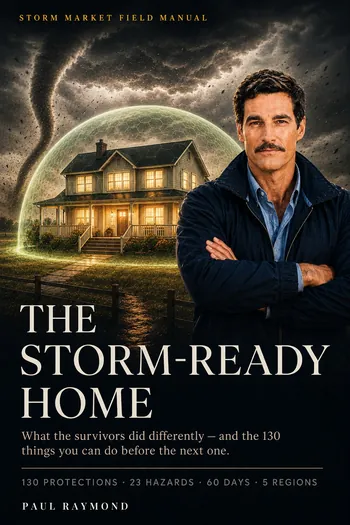
This page is one protection out of 130. The manual carries all of them, in order, with the binder forms that go with each. Get the book, $9.99 →
Tornado safe room in house: how to pick it
Walk the lowest floor and count exterior walls in each candidate room. You want zero. Look up, and rule out anything under a piano, a water heater, a masonry chimney, or a car overhead. Rule out rooms with windows: a small, high bathroom window is acceptable; a picture window is not.
- Lowest floor in the house
Basement first if you have one.
- Zero exterior walls
Count every wall of each candidate room. An interior bathroom, closet, or hallway usually wins.
- Nothing heavy overhead
Not under a piano, water heater, masonry chimney, or a parked car.
- No windows, or only a small high one
A picture window disqualifies the room.
- Under sixty seconds away
Time the slowest person in the household walking there. Over sixty seconds: pick a closer room.
Say the choice out loud to everyone tonight, and write it into your family emergency plan. In a mobile or manufactured home, no interior room qualifies: the safe room is elsewhere, and the trigger for leaving is the watch, not the warning.
Storm shelter vs safe room
The two terms get used interchangeably, and the difference matters when you're spending money. FEMA defines a "safe room" as a hardened structure built to a specific standard: currently FEMA P-361 (2021) and the referenced consensus standard ICC 500-2020: that provides what FEMA calls "near-absolute protection" in extreme wind, meaning occupants have a very high probability of being protected from injury or death. A steel box welded by a local fabricator with no design pedigree to that standard is a purchase, not a protection: it may be marketed as a "storm shelter" without meeting the safe-room standard at all.
"Is this unit tested, listed and labelled to ICC 500-2020, and will you give me that documentation in writing?"
: the question to ask before buying any above-ground unit
If the answer is vague, the answer is no. FEMA's grace period allowing older, prefabricated residential safe rooms to comply with the previous 2015/2014 editions of these standards expired on January 1, 2024: so ask specifically for the current edition.
Tornado safe room cost
If you live in a manufactured home, or in a slab-on-grade house in violent-tornado country, no interior room will do. An in-ground shelter, a garage-floor unit, or a reinforced above-ground safe room installed to the FEMA/ICC standard typically runs $3,000 to $12,000 installed. Register it with your county emergency management office if they maintain a registry, so rescuers know where to dig: a shelter you cannot be found in is a shelter that helps no one.
What should you have in a storm shelter
Once the room is chosen, stock it. This isn't a full go-bag: see our go bag checklist for that: it's what needs to be already sitting in the room, because a helmet you have to find is a helmet you will not be wearing.
- A helmet for every household member
Bicycle or sports helmets are adequate. In one CDC review of 338 deaths in the April 2011 southeastern outbreak, 21.9% of death certificates noted a head injury: about one death in five. There is no data showing helmets prevent tornado deaths, and CDC is explicit that helmets are not a substitute for shelter; they're a cheap addition on top of a good room, not instead of one.
- Real shoes and a headlamp
The room afterward may be full of broken glass and debris. A light you have to find in the dark is a light you do not have.
- A NOAA weather radio with battery backup
Outdoor sirens aren't built to be heard indoors. This is your indoor alert.
- Blankets
CDC's own recommendation is to keep blankets and helmets in the safe room itself.
- A copy of your trigger plan
So the household's agreed actions are on hand, not just remembered.
- What is the safest room in a house during a tornado?
- The interior room with the fewest or zero exterior walls, on the lowest floor, with nothing heavy able to fall through from above: most often a basement corner, or an interior bathroom, closet, or hallway on the ground floor.
- How much does a tornado safe room cost?
- An above-ground safe room built to the FEMA P-361 / ICC 500-2020 standard typically runs $3,000 to $12,000 installed. Choosing an existing interior room in your house costs nothing.
- Is a storm shelter the same as a safe room?
- Not necessarily. "Safe room" is a defined FEMA standard (FEMA P-361 / ICC 500) that near-guarantees protection in extreme wind. "Storm shelter" is used more loosely in marketing and may or may not meet that standard: always ask for the ICC 500-2020 documentation in writing.
- Do helmets actually help in a tornado?
- There's no data proving helmets reduce tornado deaths, and CDC says explicitly they are not a substitute for seeking shelter. They're a low-cost addition against head injury: which showed up in about one in five tornado fatalities in one CDC study: on top of a good safe room, never instead of one.
- FEMA, "Safe Rooms" (Building Science): FEMA P-361 (2021) and ICC 500-2020
- CDC, "Tornado-Related Fatalities: Five States, Southeastern United States, April 25–28, 2011," MMWR 2012;61(28):529–533
The room is one decision. The book covers the other 129. A 486-page manual with 130 numbered protections across 23 hazard playbooks: including the full above-ground safe room specification, structural hardening, and the 60-day sequence that orders it all.
Instant PDF · Pay once, own it forever · 7-day money-back guarantee
Not ready to buy? Get your free state packet instead: your state's specific hazards, agencies, and mitigation rules.
See also: tornado preparedness checklist, family emergency plan template, and your state's tornado risk in our state guides.
Sources for this page
Get the book
The Storm-Ready Home is a 486-page manual built from post-storm reports: 130 numbered protections, 23 hazard playbooks, the 60-day sequence, and the 61-page printable binder, every figure cited.
The printable pack free
Want all seven checklists as one printable PDF?
Every checklist on this site, laid out for the fridge door, plus three forms from the manual's binder. Emailed to you in one file.
Free. One email. Unsubscribe any time.