Free Checklist
Home inventory for insurance: the free checklist and why it pays off.
A home inventory for insurance is a dated, itemized record of what you own: photos or video, receipts where you have them, and serial numbers for anything valuable: made before a loss, not after. It's the single piece of paperwork that decides how much of a claim or disaster-assistance award you can actually prove.
Federal disaster assistance illustrates the stakes plainly. The average FEMA Individual and Household Program award is roughly $3,029, against a statutory maximum of $43,600 for housing assistance alone: and only about 10.8% of recipients ever receive the maximum. That gap isn't primarily about need; awards are determined by verified loss, insurance status, and eligibility. What a home inventory removes is the loss you cannot prove, which is the part of that gap you actually control.
This page is one protection out of 130. The manual carries all of them, in order, with the binder forms that go with each. Get the book, $9.99 →
How to build a home inventory for insurance
- Record a twenty-minute video walkthrough of every room
Narrate what's in each room as you film: closets, drawers, the garage, the attic. This single free action is one of the highest-value protections a household can take.
- Photograph anything valuable individually
Electronics, jewelry, tools, appliances: close enough to read a model or serial number where one exists.
- Keep receipts you already have
Don't go hunting for old ones. Start with what you can find in five minutes and add to it going forward.
- Date everything
A dated video or photo set proves the inventory existed before a loss, not after.
- Store a copy off-site or in the cloud
A home inventory that burns or floods with the house it documents proves nothing.
- Update it once a year
Attach the check to something you already do: a birthday, the clock change: so it doesn't go stale.
Photograph your mitigation work too
Your inventory isn't only about contents. Photograph anything that proves mitigation work was done to standard: a wind-pressure rating label inside a garage door, a sealed-roof-deck certificate, an engineer's certificate for flood vents. Several states legally require insurers to offer a discount for a documented, mitigated home; the credit is carrier-specific, and the paperwork above is exactly what your insurer will ask for before applying it.
What documentation cannot do
This is not a promise that documentation moves you from three thousand dollars to forty-three thousand. Awards are determined by verified loss, insurance status, and eligibility, and most households will never approach the statutory maximum. What documentation removes is the loss you cannot prove: which is the only part of the gap you control.
- What is a home inventory for insurance?
- A dated, itemized record of your home's contents: a video walkthrough, close-up photos of valuables, and any receipts you have: made before a loss so you can prove what you owned after one.
- Is there a free home inventory template?
- Yes, the checklist above is a free starting version. The book's full binder includes a pre-formatted home inventory form as one of its 41 fillable pages.
- Does a home inventory actually help with an insurance claim?
- It changes what you can prove, which is the part you control. A household with a dated video walkthrough and photographed valuables is in a different conversation with an adjuster than one relying on memory.
- Where should I store my home inventory?
- Off-site or in the cloud: a copy that only exists inside the house it documents can be destroyed along with the house.
- Congressional Research Service: average and maximum FEMA Individual and Household Program awards
- Federal Register, October 24, 2024 notice: FEMA IHP statutory maximum
Three of the highest-value protections in the book cost nothing. The video walkthrough. The document vault. The insurance audit that makes you read the five numbers on your own policy. All three sit in the free paper week the book places before every week that costs money: inside a 486-page manual with 130 numbered protections and the full 61-page printable binder.
Instant PDF · Pay once, own it forever · 7-day money-back guarantee
Not ready to buy? Get your free state packet instead: your state's specific hazards, agencies, and mitigation rules.
See also: emergency binder checklist, family emergency plan template, and your state's insurance and mitigation rules in our state guides.
Sources for this page
Get the book
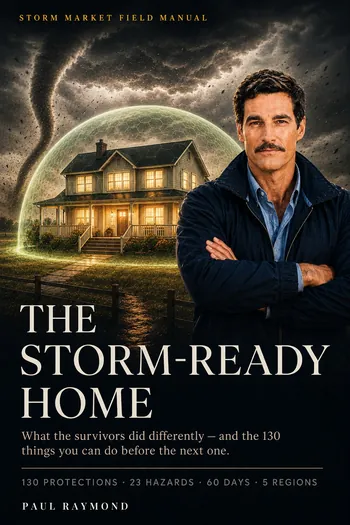
The Storm-Ready Home is a 486-page manual built from post-storm reports: 130 numbered protections, 23 hazard playbooks, the 60-day sequence, and the 61-page printable binder, every figure cited.
The printable pack free
Want all seven checklists as one printable PDF?
Every checklist on this site, laid out for the fridge door, plus three forms from the manual's binder. Emailed to you in one file.
Free. One email. Unsubscribe any time.