Free Checklist · Our Strongest Free Resource
Emergency binder checklist: what to put in it, free printables to start.
An emergency binder is a single physical folder holding everything an insurance adjuster, a hospital, or a stressed family member would need to ask you for at the worst possible moment: your documents, your home inventory, your medication list, and your household plan. Below is a free checklist to start one tonight: the full version we sell is a printable, fillable 61-page binder.
The gap between what a disaster costs you and what you actually recover from it is decided largely by paperwork, and it's decided in the days right after the event: not months later when you're finally sitting across from an adjuster. This page is the free starting version of that binder: what to include, why each section exists, and a printable checklist to fill in this weekend.
This page is one protection out of 130. The manual carries all of them, in order, with the binder forms that go with each. Get the book, $9.99 →
Why the binder matters more than people think
Federal disaster assistance has a wide gap between what most households actually receive and what they're eligible for. FEMA's Individual and Household Program pays an average award of roughly $3,029, against a statutory maximum of $43,600 for housing assistance alone. That gap isn't primarily about need: it's decided largely by what a household can prove. A household with a photographed inventory, dated damage photos, and organized records is in a different conversation with an adjuster than one relying on memory.
This is not a promise that documentation moves you from three thousand dollars to forty-three thousand. Awards are determined by verified loss, insurance status, and eligibility. What documentation removes is the loss you cannot prove: the only part of the gap you actually control.
: The Storm-Ready Home, money chapter
What belongs in an emergency binder
Start with these six sections. This is the free version: the book's full binder runs 61 printable, fillable pages across 41 separate forms, including household communication plans, medication and insurance records, and wallet cards, but this list covers the load-bearing parts you can start tonight with paper you already own.
- A photo or video walkthrough of every room
A twenty-minute phone video of your home, narrating what's in each room, dated. This is one of the highest-value protections in the entire book, and it costs nothing.
- Insurance policy numbers and your agent's contact
Homeowners or renters policy, flood policy if you have one, and the phone number to start a claim.
- Copies of identification for every household member
Driver's licenses, passports, birth certificates, Social Security cards.
- Medication list with dosages
Every prescription, dosage, and prescribing doctor, for every household member: critical if a pharmacy or doctor's office is unreachable.
- Property deed or lease, and mortgage information
Proof of ownership or tenancy, needed for both insurance and federal assistance applications.
- Household communication plan and out-of-area contact
Who to call, where to meet: see the full family emergency plan template for this section.
Where your state's mitigation credits fit in
Several states legally require insurers to offer a discount for a documented, mitigated home: Florida's statute (Fla. Stat. §627.0629) is one example. The catch is that almost no one asks, and the credit is carrier- and county-specific rather than a flat national number. Your binder is also where you keep that documentation: roof inspection reports, opening protection receipts, anything that proves the mitigation work was done to standard: because it's the paperwork your insurer will ask for before applying the credit.
What the free version doesn't include
This page gets you started with paper and a folder. The book's binder adds the fillable forms themselves: pre-formatted pages for the home inventory, the medication record, wallet cards for every household member, and the insurance audit that walks you through the five numbers on your own policy: all 61 pages, printable at a copy shop or at your kitchen table.
- What should be in an emergency binder?
- A photo or video walkthrough of your home, insurance policy numbers, copies of ID for every household member, a medication list with dosages, your property deed or lease, and your household communication plan.
- Is there a free emergency binder template?
- Yes: the checklist on this page is a free starting point you can fill in with paper you already have. The full version, with 41 pre-formatted fillable forms across 61 pages, is part of The Storm-Ready Home.
- What are emergency binder printables?
- Pre-designed pages sized to print and fill in by hand: a home inventory form, medication record, insurance summary, wallet cards, and a household communication plan: rather than a blank binder you have to design yourself.
- Does documentation actually change what I get from insurance or FEMA?
- It changes what you can prove, which is the part you control. FEMA's own figures show an average award far below the statutory maximum; documentation doesn't guarantee the maximum, but it removes the gap caused by unprovable loss.
- Congressional Research Service: average and maximum FEMA Individual and Household Program awards
- Federal Register, October 24, 2024 notice: FEMA IHP statutory maximum
- Florida Statutes §627.0629: mandated wind-mitigation insurance discounts
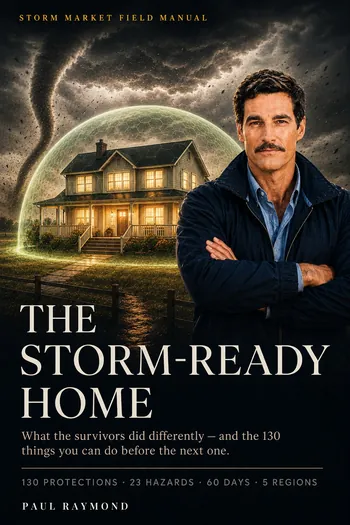
This checklist is six items. The real binder is 41 forms, 61 pages. A 486-page manual with 130 numbered protections across 23 hazard playbooks, a 60-day sequence, and the complete printable binder: household communication plan, home inventory, medication and insurance records, and wallet cards.
Instant PDF · Pay once, own it forever · 7-day money-back guarantee
Not ready to buy? Get your free state packet instead: your state's specific hazards, agencies, and mitigation rules.
See also: home inventory for insurance, family emergency plan template, and your state's mitigation rules in our state guides.
Sources for this page
Get the book
The Storm-Ready Home is a 486-page manual built from post-storm reports: 130 numbered protections, 23 hazard playbooks, the 60-day sequence, and the 61-page printable binder, every figure cited.
The printable pack free
Want all seven checklists as one printable PDF?
Every checklist on this site, laid out for the fridge door, plus three forms from the manual's binder. Emailed to you in one file.
Free. One email. Unsubscribe any time.